
As organizations expand their operations, connect more users and applications, and extend services into new locations, network architectures are becoming increasingly complex. Connectivity is often delivered through a combination of terrestrial and satellite networks, each with its own performance characteristics, operational requirements and management challenges.
SD-WAN technology helps simplify this complexity by providing a centralized framework for managing traffic across diverse connectivity options. It enables organizations to optimize network performance, improve resilience and integrate new sources of connectivity into existing WAN environments. When a new capability arrives, the practical question is not whether it can replace what already works. It is about whether it can integrate smoothly and strengthen the overall network.
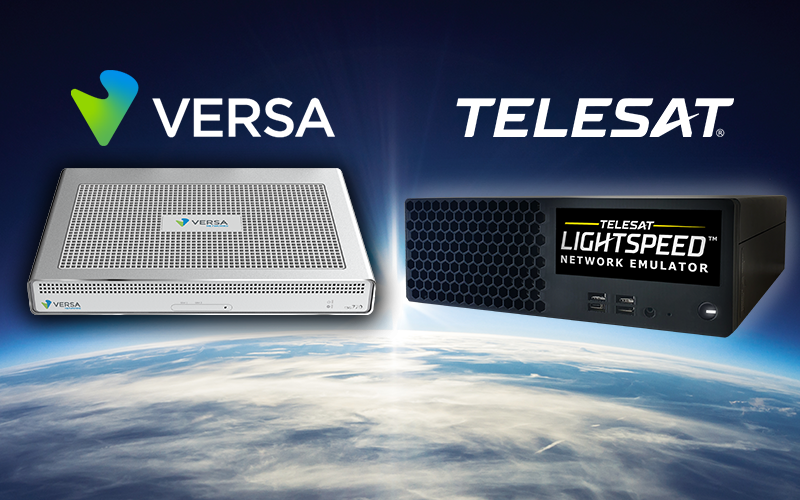
Telesat and Versa Networks recently put that question to the test. Our teams validated Versa’s software-defined wide area network (SD-WAN) technology with multiple Telesat Lightspeed user terminals. The results show how operators can aggregate capacity from multiple Telesat Lightspeed user terminals into a single logical network service, bringing significantly more bandwidth to demand hotspots while simplifying network operations. With Versa’s SD-WAN solution, that capacity can also be integrated into existing terrestrial and satellite environments without rebuilding infrastructure.
When one terminal isn’t enough
There are still many areas around the world that struggle with limited or non-existent high-capacity terrestrial infrastructure, as well as industries operating at the network edge where delivering an “in the office” connectivity experience is challenging.
A cruise ship carries thousands of passengers who expect to stream video and stay in touch with home. A remote community in the Far North without fiber may rely on LEO satellite connectivity for its schools, clinics, and businesses. In cases like these, a single user terminal may not deliver all the bandwidth a site needs and would present a single point of failure.
Adding terminals solves the capacity problem but creates a potential management problem. Each terminal has its own port and represents a separate path for traffic. Network teams want the added capacity without managing multiple independent connections, and they want resilience, so users stay online if any single link has trouble. An SD-WAN appliance addresses both by combining multiple links into what the customer sees as a single connection.

More capacity creates a new challenge
Multiple terminals solve the capacity challenge, but they also create operational complexity. Network operators need a way to combine those links into a single service, intelligently distribute traffic, prioritize critical applications and maintain service continuity when network conditions change. SD-WAN provides that control layer, enabling organizations to scale capacity while simplifying network management.
Putting the solution to the test
The teams used the Telesat Lightspeed Network Emulator, which simulates the constellation’s end-to-end behavior, to model a complete network. Four emulated Telesat Lightspeed user terminals connected to a Versa SD-WAN appliance at the customer site, and a second Versa appliance is located at the point of presence (PoP). The validation ran entirely over emulated Telesat Lightspeed LEO links.
The two appliances communicate continuously, distributing traffic across the available links and choosing a path for each flow based on service-level agreement (SLA) parameters such as jitter, latency, congestion, and bandwidth use. The teams evaluated three capabilities:
- Traffic aggregation and balancing. The appliance combined multiple WAN links into a single logical connection. SD-WAN creates a “pool” of bandwidth from all available links, allowing the network to utilize the combined capacity
- Automatic failover. When the team simulated a terminal failure, the traffic was automatically rerouted and balanced to the remaining active links with minimum disruption. This ensures uninterrupted connectivity and high availability.
- SLA-based path selection. When a link exceeded its defined thresholds, the appliances rerouted traffic to links that could meet them. Traffic was dynamically allocated across these links based on real-time conditions, using a link bandwidth estimation mechanism (latency, jitter, packet loss).
Built to fit telecom networks
One of the most important outcomes of the testing was demonstrating how easily Telesat Lightspeed can integrate into existing enterprise and service provider environments. At the demarcation point, Telesat Lightspeed delivers a Layer 2 interface that follows MEF 3.0 Carrier Ethernet standards, the same framework telecom operators use across their terrestrial networks. Customers that want to manage Layer 3 routing and IP addressing can do so on top of that interface.
The validation also reflected two ways of landing traffic. Traffic can travel through a Telesat Lightspeed PoP or land at a customer-owned private access station, keeping it on a fully private network that never transits public infrastructure. That choice helps enterprises and operators meet their own sovereignty and regulatory requirements.
Adding capacity without starting over
An important takeaway is what customers do not have to do. Many enterprises and operators already use SD-WAN to combine fiber, cellular, and satellite links from multiple providers. Telesat Lightspeed can join the existing mix in whatever way best serves the customer: as a primary path, an alternate path, or a redundant backup.
The SD-WAN appliance aggregates Telesat Lightspeed capacity with the links already in place, and it steers each type of traffic to the path that suits it best. The result is a single SD-WAN architecture that can aggregate capacity across multiple Telesat Lightspeed terminals while intelligently managing satellite and terrestrial connectivity through a common platform.
The approach applies across many environments:
- Maritime. A cruise line can add Telesat Lightspeed terminals to meet onboard demand at sea, then fold in 5G connectivity as ships approach shore.
- Remote communities. A provider serving a community without fiber access can add terminals as demand grows and present the combined capacity as one connection.
- Mobile backhaul. Operators can aggregate multiple terminals to backhaul traffic from remote cell sites.
Looking ahead
As bandwidth demands continue to grow, operators need solutions that add capacity without adding complexity. The combination of Telesat Lightspeed and SD-WAN delivers both, enabling organizations to aggregate capacity from multiple Telesat Lightspeed user terminals, bring that capacity to high demand hotspots, and integrate it seamlessly into existing network environments.
