
Military space operations are evolving at an unprecedented pace. New capabilities are being fielded faster than traditional acquisition and planning cycles were designed to accommodate, driven by the rapid advancement of commercial space technology and its growing relevance to national defense. As Department of War (DoW) leaders weigh how best to harness commercial innovation for space systems, they face a clear imperative. They must understand how these new capabilities perform, integrate, and support operations well before they reach operational availability.
This need is especially acute as commercial systems are increasingly considered for mission-critical roles. Waiting until service availability to assess performance, security, and integration introduces unnecessary operational and budgetary risk. The ability to evaluate commercial space capabilities before Initial Operational Capability (IOC) has become a strategic requirement and aligns with established defense processes, as seen in the Air Force Research Laboratory’s technology evaluations.
What IOC means for military planners
IOC marks the point at which a system is judged capable of supporting limited operational use. For military organizations, IOC is not the beginning of planning. It is the culmination of years of decisions related to budgeting, architecture, training, and operational concepts. The Government Accountability Office had reported that major defense acquisition programs (MDAPs) take, on average, almost 12 years to demonstrate capability. That is simply untenable for today’s competitive space theater.
Years before a capability reaches IOC, commanders and acquisition leaders must already understand how it fits into the broader battlespace, integrates with existing networks, and supports mission objectives under realistic conditions. Waiting to gain that understanding after IOC constrains flexibility and delays operational effectiveness. This reality underscores the value of tools that provide credible insight into performance and integration earlier in the process.
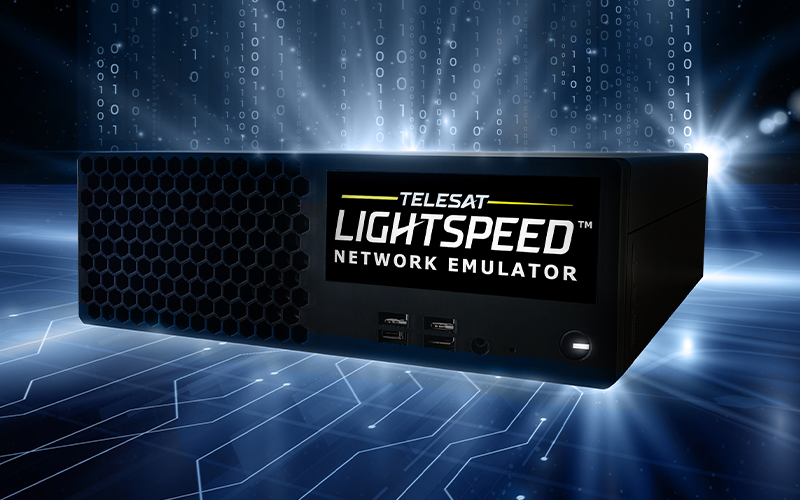
The Telesat Lightspeed Network Emulator (NetEm)
The NetEm was developed to address this challenge. It offers a plug-and-play platform with a pre-loaded Telesat Lightspeed Network configuration and standard Ethernet network interfaces for easy deployment within a command’s network. It includes a sophisticated Graphical User Interface for controlling and monitoring platform settings, services, and performance dashboards. This allows customers to test traffic, validate applications, and compare Telesat Lightspeed performance vs. other network alternatives.
From the interconnect to the user terminals, the Emulator provides an end-to-end representation of the Telesat Lightspeed network. Rather than relying on static specifications or theoretical models, the NetEm allows military users to interact with the network as it is designed to function. It supports realistic geographic scenarios, enabling planners to evaluate how connectivity performs across global service regions, operational theaters, and distributed force postures. Importantly, it does so using the same architectural principles that will govern operational service, providing confidence that what is demonstrated aligns with future reality.

Government-specific use cases
For military users, the value of the NetEm lies in its ability to address mission-relevant requirements.
One key use case is demonstrating space relay concepts. Space relay refers to connecting government or 3rd party satellites to the Telesat Lightspeed network via optical laser links to deliver data to its final destination. For example, NASA selected Telesat Government Solutions’ Space Express Service (SpES), a space data relay service, to demonstrate space relay capabilities through its Communication Services Project (CSP). NASA plans to decommission its Tracking and Data Relay Satellite (TDRS) system in the coming years. The agency’s CSP will evaluate the feasibility of commercial SATCOM networks to support future near-Earth missions reliably.
SpES has the potential to enhance resilience, flexibility, and routing options in contested or degraded environments. By incorporating the SpES feature into emulated NetEm scenarios, military planners can explore how these capabilities support operational objectives without waiting for on-orbit implementation.
For example, the proposed Golden Dome missile defense program is expected to require a global command-and-control system that will need to fuse information from multiple sources and feed it to weapons in real-time. Secure satellite communications capacity will be required from various sources, and SpES-type data transport capabilities need to be demonstrated in advance.
Security architecture is another critical consideration. The NetEm highlights the implications of a Layer 2 approach compared to traditional Layer 3 models, including support for NSA-certified Ethernet Data Encryption. For government users, this distinction matters. NetEm demonstrates the Telesat Lightspeed MEF 3.0-based Layer 2 connectivity, which simplifies integration, reduces complexity in private networking, and supports secure transport aligned with existing military network architectures.
This enhanced level of security can be demonstrated from end to end on the NetEm. Data can remain entirely within the Telesat Lightspeed constellation from source to destination, never transiting a public network, and therefore inaccessible to a potential adversary. Government customers retain total control over the encryption and decryption of their data sent over the Telesat Lightspeed network.
The NetEm also supports demonstration of multi-orbit user terminals. Military communications increasingly demand flexibility across orbits to support mobility, redundancy, and resilience. The ability to model how these terminals perform within the Telesat Lightspeed architecture provides valuable insight into future operational options.
Telesat continues to incorporate additional capabilities into NetEm in accordance with the planned enhancements to the operational system. As new capabilities are released, they can be added to deployed NetEms via a software update.
Strategic benefits for military decision-makers
Beyond technical evaluation, the NetEm delivers tangible strategic benefits.
From a budgeting and acquisition perspective, early insight into network behavior supports more accurate forecasting and justification. Decision-makers can align funding profiles with realistic expectations rather than assumptions, reducing the risk of late-stage adjustments.
Operationally, the NetEm supports improved battlespace awareness. By visualizing and testing how connectivity behaves across regions and missions, planners gain a clearer understanding of how commercial space capabilities contribute to situational awareness and command and control.
The NetEm also reinforces the U.S. military principle of “train as you fight.” By incorporating emulated commercial connectivity into exercises, wargames, and lab environments, forces can train with the same architectures they expect to use operationally. This familiarity builds confidence and reduces friction when transitioning from drilling to live execution.
Demonstrating potential at a critical moment
Commercial space technology is becoming an integral component of U.S. national defense, as speed, resilience, and flexibility are paramount. The DoW and its Allied partners are moving to new, continually advancing commercial SATCOM architectures. The Telesat offered NetEm provides a practical means to understand and evaluate these capabilities before they are operational, enabling visibility for smarter decisions across planning, acquisition, field deployment, and operations.
